
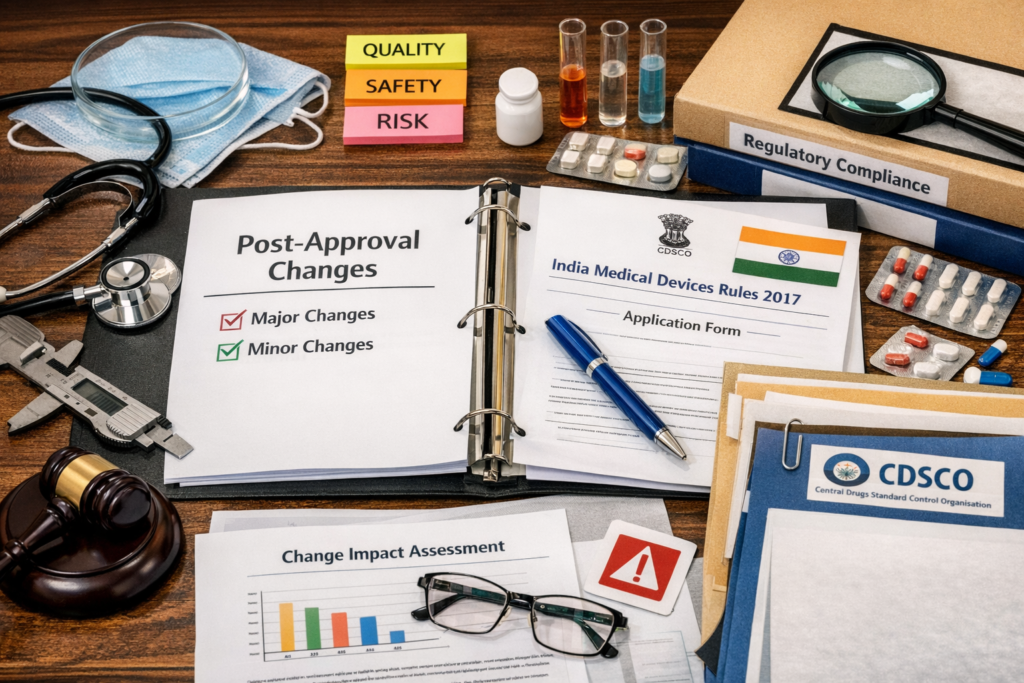
Once your medical device is approved in India, many manufacturers assume the hard work is over. In reality, post-approval change management is where a large number of regulatory issues, delays, and even license suspensions begin.
From a regulatory consultant’s point of view, misclassifying a post-approval change as “minor” when it is actually “major” is one of the most common—and costly—mistakes we see under the Indian Medical Device Rules (MDR), 2017.
This blog explains how CDSCO looks at post-approval changes, what typically qualifies as major vs minor, and how manufacturers should approach change planning without risking compliance or market continuity.
Why Post-Approval Changes Matter Under India MDR
Under India MDR, device approval is not static. Any change that impacts:
- Safety
- Performance
- Quality
- Intended use
- Regulatory classification
must be evaluated and, where required, approved by Central Drugs Standard Control Organisation (CDSCO) before implementation.
Regulators do not assess changes based on how “small” they seem operationally but on regulatory impact.
How CDSCO Distinguishes Major vs Minor Changes
Unlike some regions, India MDR does not publish a single exhaustive list. Instead, CDSCO applies a risk-based, impact-driven approach.
At a high level:
- Major Change – Requires prior CDSCO approval
- Minor Change – May be notified, documented, or reported during renewal
The deciding factor is impact on approved dossier content and risk profile.
What Is Considered a Major Post-Approval Change?
A change is generally treated as major if it affects the core regulatory basis of the original approval.
Common Examples of Major Changes
1. Change in Intended Use
- New clinical indication
- Expanded patient population
- Modified therapeutic claims
From CDSCO’s view, this is effectively a new regulatory promise.
2. Design or Performance-Affecting Changes
- Modification to core design features
- Changes impacting accuracy, sensitivity, strength, or output
- Software algorithm changes affecting clinical decision-making
3. Manufacturing Site Change
- Addition of a new manufacturing facility
- Transfer of manufacturing to a different legal entity
- Change in critical subcontractors
This is one of the most scrutinized changes during inspections.
4. Material Changes (Patient-Contacting Parts)
- New raw material
- Change in grade, supplier, or formulation
- Any impact on biocompatibility
5. Sterilization Method or Parameters
- Change in sterilization technique (e.g., EO to Gamma)
- Significant change in cycle parameters or validation approach
6. Software as a Medical Device (SaMD) Core Changes
- Algorithm logic updates
- Risk classification changes
- Cybersecurity architecture modifications
Regulatory Reality:
If the change would have required new supporting data during initial approval, CDSCO will almost always treat it as major.
What Is Typically a Minor Post-Approval Change?
Minor changes are those that do not alter the approved risk profile and do not impact safety or performance.
Common Examples of Minor Changes
1. Administrative Updates
- Manufacturer address correction (same legal entity)
- Contact person updates
- Typographical corrections
2. Labeling Changes (Non-Promotional)
- IFU formatting updates
- Grammar corrections
- Layout or font size changes
(No new claims or indications)
3. Supplier Changes (Non-Critical Components)
- Change in supplier for non-functional parts
- Packaging vendors (no barrier or sterility impact)
4. Process Optimization (Validated & Equivalent)
- Manufacturing efficiency improvements
- Equipment replacement with equivalent technology
(With validation evidence)
5. QMS Documentation Updates
- SOP restructuring
- Internal numbering changes
- Procedural clarifications
These are usually reviewed during audits or renewals, not as prior approvals.
The Biggest Mistake Manufacturers Make
From a consultant’s perspective, the most damaging assumption we see is:
This change is small, so approval is not required.
CDSCO’s response to undocumented or misclassified changes can include:
- Regulatory queries
- Application rejection during renewal
- Import license suspension
- Site inspection triggers
Intent does not override impact in regulatory assessment.
A Practical Way to Assess Your Change (Consultant Framework)
Before implementing any post-approval change, ask:
- Does this change affect intended use, safety, or performance?
- Would this change alter any section of the approved technical dossier?
- Would CDSCO ask for new data or justification if they discovered it?
- Could this change influence risk classification or labeling claims?
If the answer to any of these is yes → treat it as potentially major.
Why Early Regulatory Assessment Saves Time & Cost
Engaging a regulatory consultant before implementing a change helps:
- Avoid retroactive approvals
- Prevent market supply disruption
- Reduce CDSCO scrutiny during audits
- Maintain long-term compliance confidence
At Titans Medical Consulting, we routinely help manufacturers:
- Classify post-approval changes correctly
- Prepare CDSCO-aligned change justifications
- Decide between notification, amendment, or fresh approval routes
Conclusion:
Under India MDR, post-approval compliance is continuous, not a one-time milestone.
A well-managed change strategy protects:
- Your license
- Your market access
- Your brand credibility with regulators
If you are planning—or have already implemented—a post-approval change and are unsure of its regulatory impact, a structured assessment before CDSCO asks questions can save months of delay.
For strategic guidance on post-approval change classification and CDSCO submissions, you may reach out to Titans Medical Consulting.