
Introduction
Malaysia has rapidly emerged as one of ASEAN’s key medical device markets, driven by growing healthcare infrastructure, increasing demand for innovative devices, and a regulatory system aligned with international standards.
For manufacturers and regulatory professionals aiming to enter this market, understanding the Medical Device Conformity Assessment process is essential.
This process, governed by the Medical Device Act 737 and regulated by the Medical Device Authority (MDA), ensures that every medical device placed on the Malaysian market meets the required safety, quality, and performance standards.
1. Overview of Malaysia’s Regulatory Framework
Malaysia’s medical device regulations are administered by the Medical Device Authority (MDA), an agency under the Ministry of Health. The regulatory framework is built upon:
- Medical Device Act 737 (2012) : Governs registration, licensing, and conformity assessment.
- Medical Device Regulations 2012 : Provides procedural and operational details for compliance.
The MDA mandates two key registrations:
- Establishment Registration : For manufacturers, importers, distributors, and authorized representatives.
- Medical Device Registration : For each device intended for supply in Malaysia.
Together, these ensure both the organization and the device meet Malaysia’s regulatory expectations.
2. What is Conformity Assessment?
Under MDA guidelines, a Conformity Assessment is the process by which a medical device is evaluated to confirm it meets essential principles of safety and performance.
This step is crucial before registration and involves review and verification by an MDA-recognized Conformity Assessment Body (CAB).
The outcome of this evaluation is a CAB Certificate, which forms a prerequisite for device registration with the MDA.
Purpose of Conformity Assessment:
- Ensure device safety and performance.
- Verify that quality management systems (QMS) are in place.
- Confirm compliance with labeling and documentation requirements.
3. Step-by-Step Process of Conformity Assessment
Step 1: Determine Device Classification
Medical devices in Malaysia are classified into four categories — Class A (low risk) to Class D (high risk) based on intended use and risk to patients.
Step 2: Select an MDA-Recognized CAB
Manufacturers must choose an appropriate Conformity Assessment Body based on their device class.
- Class A devices undergo self-declaration.
- Classes B, C, and D require assessment by a CAB.
Step 3: Prepare and Submit Technical Documentation (CSDT)
The Common Submission Dossier Template (CSDT) must include detailed technical, safety, and clinical information as per MDA requirements.
Step 4: CAB Review and Audit
The CAB reviews the documentation and may perform a QMS audit or on-site verification depending on device class and risk.
Step 5: Issuance of CAB Certificate & MDA Registration
Once compliance is confirmed, the CAB issues a Certificate of Conformity.
Manufacturers can then proceed to register the device with MDA through the MedCast system.
4. Role of Conformity Assessment Bodies (CABs)
CABs play a critical role in Malaysia’s regulatory ecosystem. These organizations are accredited and recognized by the MDA to perform conformity assessments on behalf of manufacturers.
Types of Assessments Conducted:
- Technical documentation verification
- Quality management system audits (ISO 13485)
- Clinical evidence review
Under the ASEAN Medical Device Directive (AMDD) framework, assessments from recognized ASEAN CABs may sometimes be accepted or waived to facilitate regional trade and reliance mechanisms.
5. Key Documents Required
To initiate a conformity assessment, manufacturers should prepare the following:
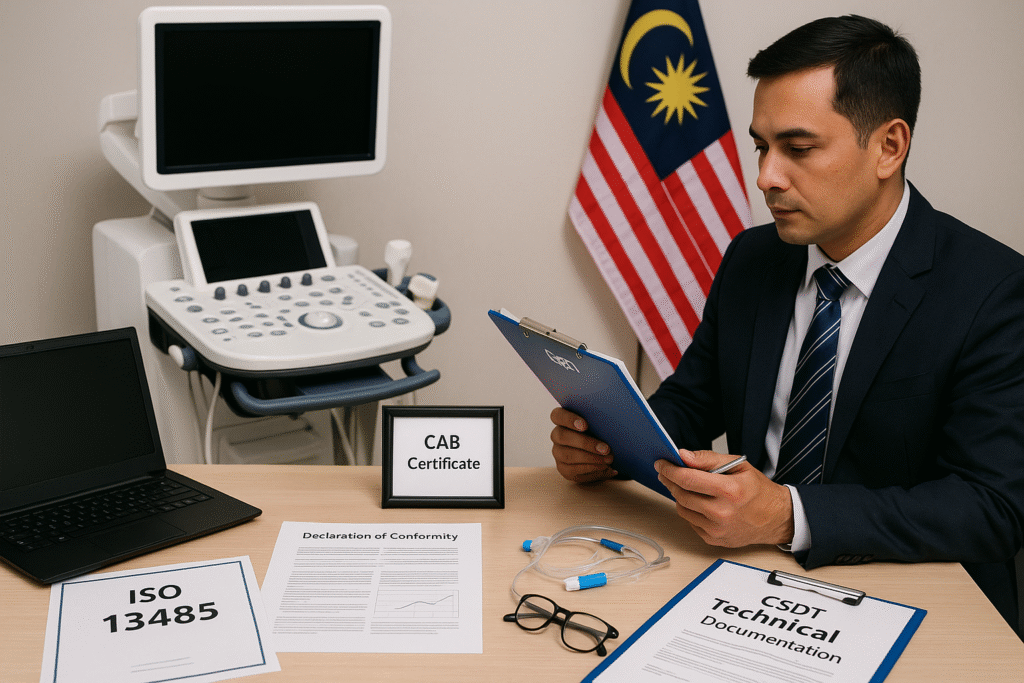
- Valid ISO 13485 QMS Certificate
- Test reports and clinical data (if applicable)
- Declaration of Conformity (DoC) signed by the manufacturer
- Device labeling, artwork, and IFU in compliance with MDA’s labeling requirements
- CSDT or technical documentation consistent with ASEAN CSDT format
6. Common Challenges & Practical Tips
Frequent Issues:
- Incomplete or inconsistent technical documentation
- Misclassification of medical devices
- Submission through non-recognized CABs
- Missing clinical performance evidence for higher-risk devices
Tips for Smoother Approval:
- Conduct a pre-submission classification check with the MDA.
- Engage with an MDA-recognized CAB early in the process.
- Maintain an updated ISO 13485 certification and ensure your QMS aligns with MDA’s expectations.
- Ensure the Declaration of Conformity and labeling strictly follow MDA format.
A proactive and well-structured conformity assessment can significantly reduce review timelines and prevent rejections or delays during MDA registration.
7. Conclusion
The Malaysian Medical Device Conformity Assessment Framework ensures that only safe, effective, and high-quality medical devices reach the market.
For manufacturers and regulatory professionals, mastering this process not only ensures compliance but also accelerates market entry into Malaysia’s growing healthcare sector.