
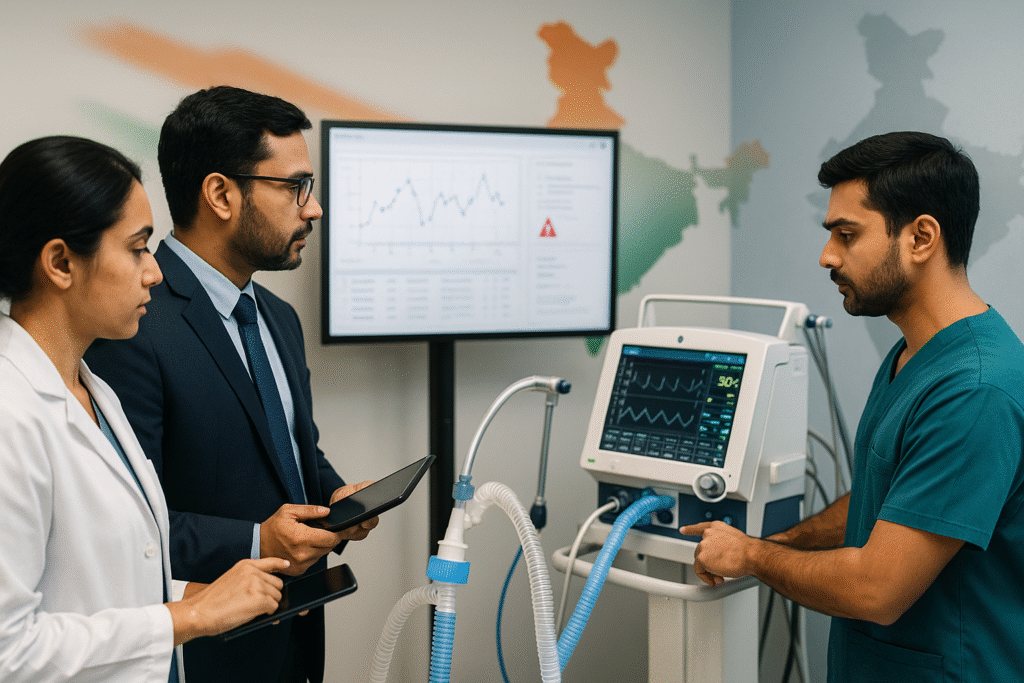
1. Introduction: Why PMS Is Critical for Respiratory Devices
Respiratory devices such as ventilators, oxygen concentrators, CPAP/BiPAP units, and nebulizers play a pivotal role in supporting or sustaining breathing. Unlike many lower-risk medical devices, these instruments operate in direct interface with patients’ respiratory systems, often in life-critical scenarios. Even minor failures—such as alarm mis-triggering, sensor drift, or circuit leaks—can lead to serious patient harm.
Given their critical nature, respiratory devices carry heightened regulatory scrutiny in many jurisdictions, and India is no exception. For manufacturers, importers, and distributors that have successfully navigated CDSCO registration and licensing, Post-Market Surveillance (PMS) becomes the essential mechanism to ensure safety, compliance, and regulatory confidence throughout the device lifecycle.
Under India’s Medical Device Rules, 2017 (MDR 2017), the obligation for PMS is enshrined in Chapter IX, Rules 25 through 30. Thus, PMS is not a discretionary activity it is a mandated regulatory responsibility to monitor, detect, correct, and report real‐world issues even after product launch.
In this guide, Titans Medical Consulting unpacks the PMS obligations specific to respiratory devices in India, illuminating how to build a compliant PMS system, common pitfalls, and practical examples tailored to ventilators, CPAPs, and related equipment.
2. Understanding CDSCO’s PMS Framework
Definition and Regulatory Basis
Under MDR 2017, PMS refers to the processes that medical device stakeholders must maintain to monitor device performance, handle complaints, initiate corrections, and report adverse events after the device is on the market. The definitions and duties are laid out in Chapter IX (Rules 25 to 30).
Rules 25–30 cover a spectrum of post-market duties including:
- complaint handling and review (Rule 25)
- field safety corrective actions (Rule 28)
- vigilance reporting (Rule 26)
- PSUR submission (Rule 29)
- obligations of the Medical Device Officer and powers of CDSCO (Rule 30)
Roles and Responsibilities
- Manufacturer: The primary responsibility lies with the manufacturer. It must institute systems to collect complaints, analyze trends, implement CAPA (corrective and preventive actions), and prepare PSURs.
- Importer/Authorized Representative: In cases of imported devices, the importer or authorized representative in India must ensure PMS is implemented, coordinate vigilance reporting, and maintain traceability to the manufacturer.
- Distributors/Servicers: Though not explicitly defined in MDR 2017, distributors and service organizations are expected to pass complaints, maintenance logs, and field service data back to the manufacturer/importer.
CDSCO may, through its Medical Device Officers or testing officers, call for PMS records or conduct inspections under Rule 30.
Core Components of a PMS System
A robust PMS system for respiratory devices should include:
- Complaint Handling & Trending
Capture all customer complaints, service reports, and user observations. Use structured logging (with categories, severity, root cause) and trending to detect unusual patterns over time. - Field Safety Corrective Actions (FSCA)
When a defect poses a safety risk, the manufacturer must initiate FSCA — e.g., recall, software update, user advisory — and document justification, scope, and effectiveness of the action. - Vigilance Reporting (Adverse Events)
For serious incidents, mandatory reporting to CDSCO via Forms MD-24 (Initial Report) and MD-25 (Follow-Up) is required under Rule 26. - Periodic Safety Update Reports (PSUR)
A periodic summary of device performance—including adverse events, complaints, trend analysis, CAPA status, and benefit–risk evaluation. Submitted to CDSCO under Rule 29. - CAPA Documentation & Follow-Up
For all investigations and corrective actions, maintain documented root-cause analysis, verification of fixes, and monitoring of recurrence.
These components must be interlinked in a continuous feedback loop: complaint → investigation → trend → CAPA → monitoring → reporting.
If CDSCO has issued a separate Guidance Document on PMS / Vigilance, it should be referenced; however, at present, CDSCO’s public site offers limited device-specific PMS guidance beyond MDR 2017.
3. PMS for Respiratory Devices: Practical Implications
Common Safety Risks in Respiratory Devices
Respiratory devices carry several risk vectors requiring vigilance:
- Sensor drift or calibration error (e.g. pressure or flow sensors)
- Alarm failure or false alarms (leading to ignored alarms or missed alerts)
- Circuit leaks or disconnections
- Power or battery failure during critical use
- Software bugs or firmware corruption
- Contamination or blocked filters affecting airflow
Because respiratory devices often have software, sensors, and complex control systems, the manufacturer must monitor both hardware and software performance in the field.
Impact of Device Classification (B, C, D)
Under MDR 2017, respiratory devices often fall into Class C or Class D, depending on intended use, invasiveness, and risk. India maintains a classification list of “Respiratory” devices on the CDSCO site.
Higher classes demand more vigilance:
- For Class C / D devices, vigilance reporting and PSUR scrutiny are more intense.
- Greater expectations for root cause analysis, service traceability, and user feedback mechanisms.
Lower-risk devices (Class B) may have lighter reporting burdens, but still cannot skip complaint capture and trend analysis.
Traceability & Data Integrity
To enable effective PMS, respiratory devices must be traceable to the individual unit level via:
- Serial numbers or unique device identifiers (UDIs or internal equivalent)
- Device history records (DHRs) including maintenance, calibration, repairs
- Service logs and field maintenance reports
- Software version logs and update history
Without strong traceability, linking adverse events back to device batches or configurations becomes impossible, undermining effective CAPA and reporting.
Real-World Example: Ventilator Alarm Malfunction
Consider a ventilator model deployed across multiple hospitals. After a few months, two separate units report failure of a pressure alarm to trigger under overpressure condition.
- The complaint gets logged.
- Investigation reveals a firmware bug under specific operating modes.
- A Field Safety Corrective Action (FSCA) is issued, and updated firmware is pushed to all units in the field.
- The manufacturer files initial report (MD-24) to CDSCO within 15 days, explaining the problem and corrective steps.
- In the next PSUR, the trend is included, showing no further incidents after the patch, and root-cause data is documented.
- CDSCO reviews and may ask clarifications or audit the CAPA.
This cycle is representative of PMS in action for high-risk respiratory devices.
4. PMS Reporting Requirements & Timelines
Serious Adverse Events (SAE) – Rule 26
Under Rule 26, the manufacturer or importer must submit a Serious Adverse Event (SAE) report to CDSCO within 15 calendar days of becoming aware of it.
An SAE is defined as an event that:
- Causes death, permanent impairment or harm, or
- Necessitates medical or surgical intervention to prevent permanent damage
- Or compromises the benefit–risk balance
The format is Form MD-24 (initial report), followed by Form MD-25 (follow-up report) with further findings, root-cause, and corrective measures.
Failure to report within 15 days may lead to regulatory action, including show-cause notices or license suspension.
Non-Serious Complaints & Trends → PSUR in Rule 29
Not all complaints are SAEs. Non-serious complaints (e.g. minor malfunction, nuisance alarms) must be aggregated, analyzed, and included in the PSUR submission under Rule 29.
The PSUR should reflect:
- Volume and nature of complaints
- Trend analysis (e.g. by severity, batch, usage hours)
- Corrective actions implemented
- Benefit–risk reassessment
- Any FSCA executed
- CAPA effectiveness monitoring
PSUR Submission Schedule (Rule 29)
The timing for PSUR submissions is:
- Every 6 months for the first two years after placing the device on the market.
- Annually for the next two years (i.e. years 3 and 4).
- After that, as per CDSCO direction (or until device is withdrawn) CDSCO
The PSUR submission should be in the format prescribed by CDSCO (if published) or follow standards consistent with regulatory expectations. Supporting evidence (complaint logs, investigation data, trend charts, CAPA records) must accompany the PSUR.
Once submitted, CDSCO may evaluate, raise queries, or audit the PMS documentation.
CDSCO’s Powers & Oversight (Rule 30)
Under Rule 30, the Medical Device Officer has authority to:
- Conduct inspections and demand PMS records
- Require device recall, adverse action, or suspension
- Ensure compliance with PMS obligations
Rule 30 ensures that PMS is not theoretical — regulatory oversight can penetrate field systems.
5. Alignment with Global Standards
While this article focuses on India’s regulatory reality, it is instructive to note how India’s PMS obligations parallel global rules:
- In EU MDR (Articles 83–86), manufacturers must maintain a post-market surveillance system, prepare Periodic Safety Update Reports (PSURs), and implement corrective measures — analogous to India’s structure.
- In US FDA (21 CFR 803, postmarket requirements), mandatory Medical Device Reporting (MDR) rules and correction/removal reporting obligations exist.
India’s PMS model shows growing alignment with these mature regulatory regimes, enhancing international acceptability of Indian-registered devices. The emphasis on vigilance, trend analysis, CAPA, and reporting reflects a global convergence of medical device safety frameworks.
6. Common Compliance Gaps Observed
From our regulatory audits and client engagements, Titans Medical Consulting often encounters the following PMS shortcomings in respiratory-device portfolios:
- Incomplete or unstructured complaint logs: lacking standard fields (e.g. device ID, severity, root cause)
- Delayed vigilance reporting: discovering an SAE but missing the 15-day window
- Failure to trend minor complaints: treating them individually rather than analyzing batches
- Viewing PMS as documentation only: generating PSURs mechanically rather than using real post-market feedback
- Poor CAPA tracking: no follow-up to verify fixes or recurrence
- Lack of training or awareness: PMS responsibilities not built into quality or service teams
Compliance reminders:
- Develop and maintain robust SOPs for complaint intake, investigation, CAPA, FSCA, and reporting
- Train quality, R&D, and service staff in PMS obligations and timelines
- Conduct internal audits and mock regulatory reviews of PMS records
- Use dashboards or trend analytics to surface early warnings
- Ensure quality of documentation: timestamping, version control, traceability, audit trails
Addressing these gaps proactively helps avoid regulatory enforcement and ensures product safety continuity.
Role of Titans Medical Consulting
At Titans Medical Consulting, we specialize in assisting medical device manufacturers, importers, and distributors to build regulatorily compliant PMS systems from the ground up.
Our offerings include:
- Designing complaint-handling workflows and databases
- Drafting SOPs for PMS, CAPA, FSCA, vigilance, and audit control
- Preparing and reviewing PSUR submissions and vigilance reports (MD-24 / MD-25)
- Establishing service traceability mechanisms and maintenance logs
- Conducting mock audits and PMS readiness assessments
By partnering with us, you ensure your respiratory device remains safe, compliant, and trusted throughout its lifecycle — not just at the moment of market entry.
Sources: All information in this article is drawn from official CDSCO and MoHFW publications, including the Medical Device Rules, 2017 (Chapter IX) and CDSCO guidance documents on Post-Market Surveillance.