
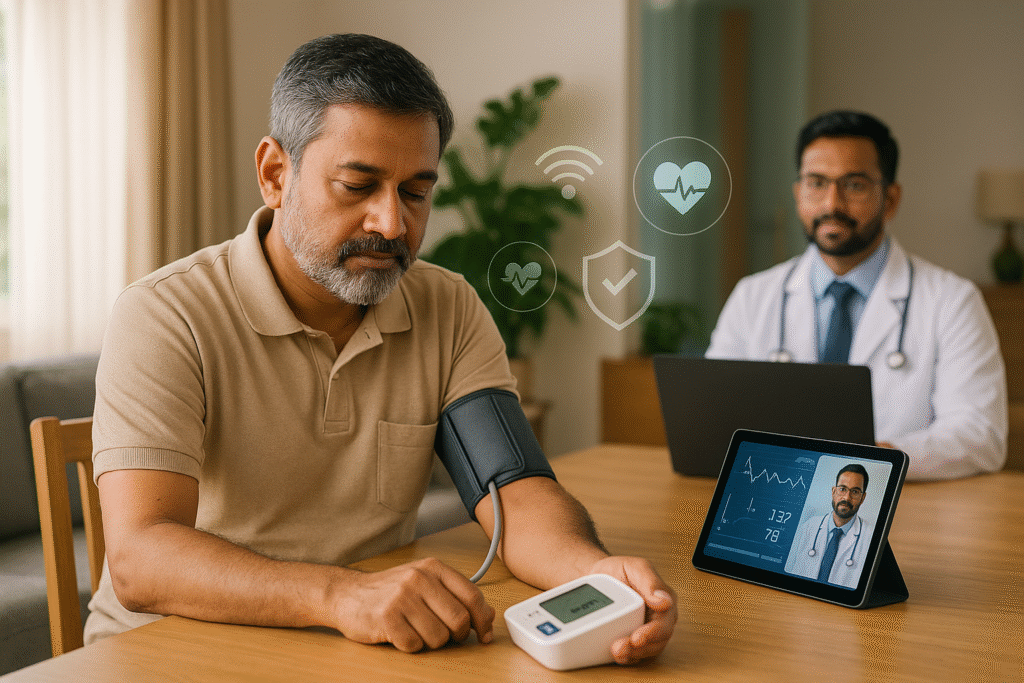
Introduction: The Shift Toward Home-Based Healthcare in
India
India’s healthcare landscape is undergoing a major
transformation. As patients increasingly prefer convenience, affordability, and
real-time access to care, home-based healthcare and remote patient monitoring
(RPM) have emerged as powerful solutions bridging the gap between hospitals and
homes.
According to a 2024 NASSCOM report, India’s digital health
market is projected to reach USD 37 billion by 2030, with remote monitoring
devices expected to form one of the fastest-growing segments. Similarly,
Research and Markets forecasts a compound annual growth rate (CAGR) of over 15%
for remote patient monitoring devices in India between 2024 and 2030.
From BP monitors and glucose meters to wearable ECGs and
smart oximeters, the rise of connected medical devices is transforming chronic
disease management and preventive healthcare across urban and rural India
alike.
Why Home & Remote Monitoring Devices Are Gaining
Importance
Several key trends are fueling this rapid expansion:
1. The National Digital Health Mission (NDHM)
India’s Ayushman Bharat Digital Mission (ABDM) aims to
create a unified digital health ecosystem by linking patients, healthcare
providers, and technology platforms. Remote monitoring devices play a crucial
role by generating reliable, real-time patient data compatible with digital
health records.
2. Rising Chronic Disease Burden
Non-communicable diseases (NCDs) such as diabetes,
hypertension, and cardiovascular disorders now account for over 60% of deaths
in India, according to WHO. These conditions require continuous monitoring,
making home-use medical devices indispensable.
3. Increasing Device Adoption and Awareness
The COVID-19 pandemic accelerated telehealth adoption. Urban
consumers and even semi-rural populations are now embracing connected
oximeters, digital thermometers, ECG patches, and smart BP monitors for
continuous health tracking.
Together, these factors have turned remote health monitoring
in India from a niche innovation into a mainstream healthcare solution but
entering this market requires navigating India’s regulatory landscape
effectively.
Understanding CDSCO Classification for Home-Care Devices
The Central Drugs Standard Control Organization (CDSCO)
regulates all medical devices in India under the Medical Device Rules, 2017.
Home and remote patient monitoring devices are classified based on their intended
use and risk into four categories:
|
Class |
Risk Level |
Example Devices |
|
Class A |
Low risk |
Digital thermometers,
electronic weighing scales |
|
Class B |
Low–moderate
risk |
BP monitors,
pulse oximeters, glucometers |
|
Class C |
Moderate–high risk |
ECG monitors, wearable
cardiac monitors |
|
Class D |
High risk |
Life-supporting
remote monitoring systems, advanced telemetry devices |
For manufacturers, correct device classification is critical
because it determines the regulatory submission pathway, testing requirements,
and approval timelines.
CDSCO Registration Pathway for Home & Remote Patient
Monitoring Devices
To legally market a home-use or remote monitoring device in
India, manufacturers or importers must obtain a CDSCO registration certificate.
Here’s how the process works:
Step 1: Determine Device Classification and Predicate
Status
- Identify
the device class (A–D) as per the First Schedule of the Medical Device
Rules, 2017.
- Check
if the device has a predicate (similar approved device) in India.
- Predicate devices allow
a simplified route.
- Non-predicate (novel)
devices require additional evaluation.
Step 2: Prepare Key Technical Documents
Manufacturers must prepare a comprehensive set of technical
documents, including:
- Device
Master File (DMF) : covering design, materials, biocompatibility, risk
management, labeling, and sterilization details.
- Plant
Master File (PMF) : detailing manufacturing facilities, quality control,
and environmental conditions.
- Test
Reports & Certifications : from accredited labs for performance and
safety.
- Clinical
Evaluation Report (CER) : demonstrating safety and efficacy.
- Free
Sale Certificate (FSC): if the product is marketed in other countries.
Step 3: File the Application on the SUGAM Portal
All applications must be submitted online via the CDSCO’s
SUGAM portal:
- Form
MD-14 : Application for import license
- Form
MD-15 : Import license issued after review and approval
For domestic manufacturers, the process involves:
- Form
MD-3 : Application for manufacturing license
- Form
MD-5 : License granted by the State Licensing Authority (SLA)
Step 4: Review and Approval
CDSCO evaluates the technical dossier and may request
clarifications or additional data. For higher-risk classes (C & D), the Subject
Expert Committee (SEC) may conduct a technical review before final approval.
Essential Standards and Certifications for Compliance
To demonstrate compliance and ensure safety, manufacturers
must align with both Indian and international standards:
Quality Management and Manufacturing Standards
- ISO
13485:2016 Quality Management System for Medical Devices
- Good
Manufacturing Practices (GMP) under Schedule V of the Medical Device Rules
Product Safety and Performance Standards
- IEC
60601-1-11 : Medical electrical equipment for home healthcare environments
- IEC
62304 : Software lifecycle processes for medical device software
- BIS
Certification : Mandatory for certain electronic and wireless devices
under the Bureau of Indian Standards (BIS)
Risk Management and Usability
- ISO
14971 : Risk management for medical devices
- IEC
62366 : Usability engineering for medical devices
These standards not only facilitate CDSCO approval but also
ensure global acceptance if you plan to export.
Common Challenges Faced by Manufacturers
Despite growing opportunities, many manufacturers encounter
regulatory hurdles that delay product launches. Some of the most frequent
issues include:
- Incorrect
classification of devices (e.g., wearable ECGs often misclassified as
Class B instead of Class C).
- Incomplete
Device Master File (DMF) lacking clinical or validation data.
- Missing
BIS compliance reports, particularly for electronic or wireless devices.
- Unclear
predicate device justification, especially for novel or AI-enabled
systems.
- Software
validation gaps where IEC 62304 documentation is not provided.
- Delayed
responses to CDSCO queries during the review process.
These errors can result in license rejection or significant
delays in market entry underlining the importance of expert regulatory
guidance.
Post-Market Surveillance (PMS) Requirements
Once a device is approved and placed on the market,
manufacturers and importers must ensure ongoing safety and performance through post-market
surveillance (PMS).
Under Chapter XI of the Medical Device Rules, 2017, the
following obligations apply:
- Periodic
Safety Update Reports (PSURs) must be submitted to CDSCO.
- Complaint
Handling System to record and assess adverse events.
- Field
Safety Corrective Actions (FSCAs) required in case of device malfunction
or recall.
- Reporting
of Adverse Events to the Materiovigilance Programme of India (MvPI).
A robust PMS system not only fulfills compliance obligations
but also builds long-term trust with healthcare providers and end users.
How Titans Medical Consulting Helps
At Titans Medical Consulting, we specialize in
guiding manufacturers and importers through India’s evolving regulatory
landscape for home-use and remote patient monitoring devices.
With Titans Medical Consulting as your partner, you can
minimize regulatory risk, accelerate approvals, and confidently expand your
footprint in the Indian medical device market.
Conclusion
India’s digital health revolution is unfolding rapidly, and remote
patient monitoring devices are at the center of this evolution. However,
regulatory compliance is not just a box-ticking exercise it’s a foundation for patient safety, product
credibility, and faster market access.
By understanding India’s Medical Device Rules 2017, ensuring
BIS certification for medical devices, and following the CDSCO registration
pathway, manufacturers can unlock enormous potential in the growing home and
remote health monitoring market in India.
Contact Titans Medical Consulting
Ready to bring your home or remote patient monitoring device
to the Indian market?
Contact Titans Medical Consulting to streamline your CDSCO registration and
ensure full compliance with India’s regulatory roadmap.