
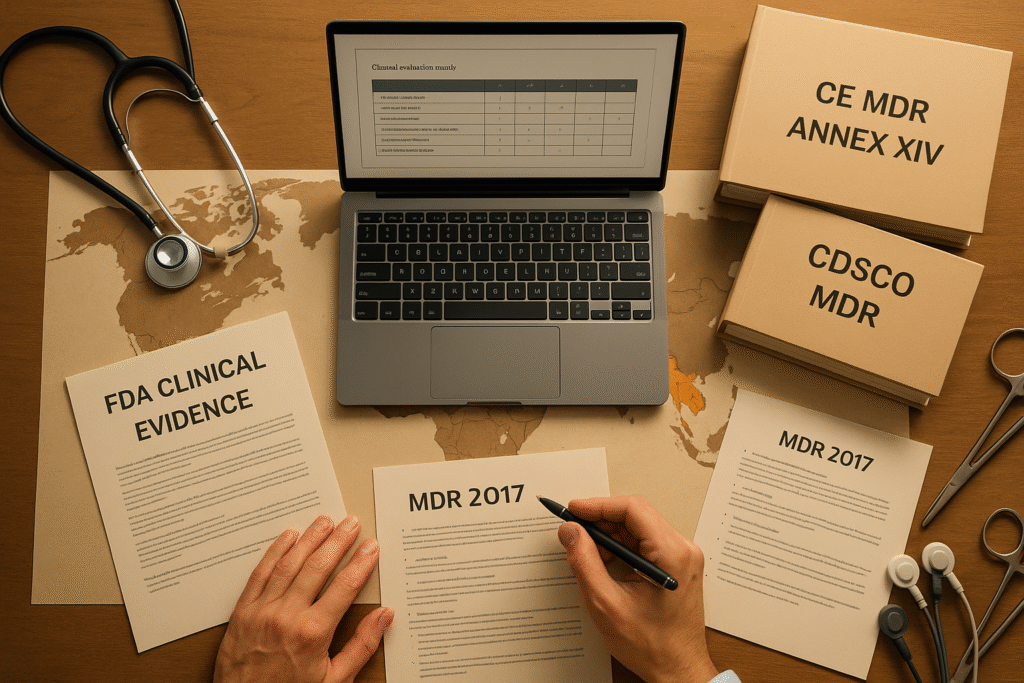
Global medical device manufacturers expanding into India often ask a common question: “Can we reuse our FDA or CE evidence for CDSCO registration?”
The short answer: Yes, if the data is mapped, justified, and repurposed correctly.
India’s regulatory framework under the CDSCO Medical Device Rules, 2017 (MDR 2017) strongly emphasises safety, performance, and clinical evaluation. This aligns well with global principles in the FDA Clinical Evidence Guidance and EU MDR Annex XIV, making evidence bridging both possible and efficient.
As consultants, we routinely help manufacturers reduce duplication, shorten timelines, and save significant cost by leveraging existing global evidence. Here is a practical roadmap to help you do the same.
Why Repurposing Global Evidence Matters for Indian Market Entry
Manufacturers entering India often assume new local clinical data is mandatory. In reality:
- CDSCO accepts global clinical evidence when relevance is justified.
- FDA and CE submissions already contain robust risk, performance, and clinical datasets.
- Smart mapping helps avoid unnecessary clinical investigations in India.
From a consultant’s perspective, the strategic advantage is clear:
Reuse whenever possible; generate fresh evidence only when essential.
1. Understand the Foundation: What Each Regulator Expects
FDA (Clinical Evidence Guidance) focuses on:
- Valid scientific evidence
- Real-world clinical use conditions
- Risk–benefit analysis
- Device performance vs. predicate (for 510(k))
EU MDR Annex XIV requires:
- Continuous Clinical Evaluation
- Clinical Evidence that proves General Safety & Performance Requirements (GSPRs)
- Post-market clinical follow-up (PMCF) planning
- Literature + clinical investigation equivalence justification
CDSCO MDR 2017 requires:
- Essential Principles of Safety & Performance (Schedule I)
- Clinical Performance Evaluation (Annexure A)
- Clinical Investigation exemption criteria
- Global evidence if clinically relevant to Indian population
Together, these frameworks share one core principle:
Evidence must correlate to intended use, design, risk, and patient population.
2. What Indian Regulators Accept and What They Don’t
CDSCO Accepts:
· FDA/CE clinical data
· Post-market safety data
· Bench and preclinical test reports
· Literature-based clinical evaluation
· Equivalence data for similar devices
CDSCO Does Not Accept Without Justification:
· Evidence from unrelated indications
· Data for devices with major cultural, anatomical, or usage differences
· Poorly structured clinical evaluation reports
Manufacturers often fail not because data is missing, but because mapping is missing.
3. How to Repurpose FDA & CE Data Into CDSCO Format (Consultant Framework)
This section reflects the workflow we use at Titans Medical Consulting for our clients.
Step 1: Align Intended Use Across Regions
Differences in wording between FDA, CE, and India can create red flags.
We map:
- Indications
- User profile (physicians, technicians, lay users)
- Patient group
- Contraindications
Even minor discrepancies can lead to requests for clarification or clinical investigation.
Step 2: Build an “Evidence Mapping Matrix”
A practical tool to show CDSCO exactly how global evidence supports Indian requirements.
CDSCO Requirement | Source (FDA/CE) | Document Type | Mapping Summary |
Essential Principles | FDA safety data | Bench testing | Performance meets Schedule I EPs |
Clinical Evaluation | EU Annex XIV CER | Literature + studies | Equivalent device, same intended use |
Risk Management | CE Risk File | ISO 14971 Risk Report | Risks mitigated similarly in India |
PMS Data | FDA MAUDE / EU vigilance reports | Post-market evidence | Demonstrates global safety |
This matrix becomes the backbone of the Indian submission.
Step 3: Rebuild the Clinical Evaluation in an Indian-Friendly Format
CDSCO expects a Clinical Performance Evaluation Report (CPER) that includes:
- Device description
- Global clinical evidence summary
- Relevance to Indian population
- Risk–benefit analysis
- Post-market surveillance
- Equivalence justification
We repurpose FDA study data and EU clinical evaluation to create a CDSCO-ready CPER.
Step 4: Establish “Population Relevance” Justification
One of the biggest concerns for CDSCO is:
Will global evidence represent Indian users?
We build a justification based on:
- Physiological comparability
- Disease prevalence
- Clinical practice similarities
- Bench test conditions
- Existing India usage (if distributed via hospitals previously)
This step prevents demands for local clinical studies.
Step 5: Determine Whether Local Clinical Investigation is Needed
Under CDSCO MDR 2017, clinical investigation may be waived if:
- Device has long global clinical history
- Evidence is robust (FDA PMA/510k or CE MDR)
- No India-specific risks
- Device is not novel or high-risk in the Indian context
We prepare a strong justification referencing FDA & CE documentation.
4. When Can’t You Reuse Global Evidence?
Manufacturers may need fresh Indian data if:
- Device is novel with no equivalent
- Intended use differs from global markets
- High-risk (Class C/D) with limited global clinical history
- Unique Indian usage environments (e.g., high humidity, variable infrastructure)
We guide manufacturers on whether bridging is enough or clinical work is needed.
5. Common Mistakes Manufacturers Must Avoid
Based on real-world consulting experience:
1. Copy-pasting FDA or CE clinical sections
CDSCO expects India-specific alignment—not wholesale replication.
2. Ignoring Schedule I Essential Principles
Global data must be mapped to each EP clearly.
3. Not addressing Indian patient relevance
Nothing triggers queries faster.
4. Missing PMS data from FDA MAUDE/EU vigilance
CDSCO values real-world safety evidence.
5. Poor structuring of Clinical Evaluation
India expects a CER-style technical narrative, not FDA-style summary reports.
6. How Regulatory Consultants Add Value
As consultants, our role is to ensure:
- Zero evidence duplication
- Maximum leveraging of global data
- Strong justifications to avoid local clinical studies
- Faster approval timelines
- Risk-driven documentation that satisfies CDSCO reviewers
Most manufacturers over-submit or mis-submit data.
A structured, India-aligned evidence mapping approach avoids this.
Conclusion:
India is one of the fastest-growing medical device markets globally.
With the right evidence strategy based on:
- FDA Clinical Evidence Guidance
- EU MDR Annex XIV
- CDSCO MDR 2017
Manufacturers can confidently repurpose global clinical and performance data to meet Indian regulatory expectations.
A robust evidence mapping matrix, a well-designed clinical evaluation, and clear population relevance justification dramatically reduce approval timelines.
Sources
- FDA – “Clinical Evidence Requirements for Medical Devices: Guidance for Industry.” U.S. Food & Drug Administration.
- European Union Medical Device Regulation (EU MDR) 2017/745 – Annex XIV: Clinical Evaluation and PMCF Requirements.
- India – Medical Device Rules, 2017 (CDSCO) – Including Schedule I (Essential Principles of Safety & Performance) and Clinical Investigation provisions.