
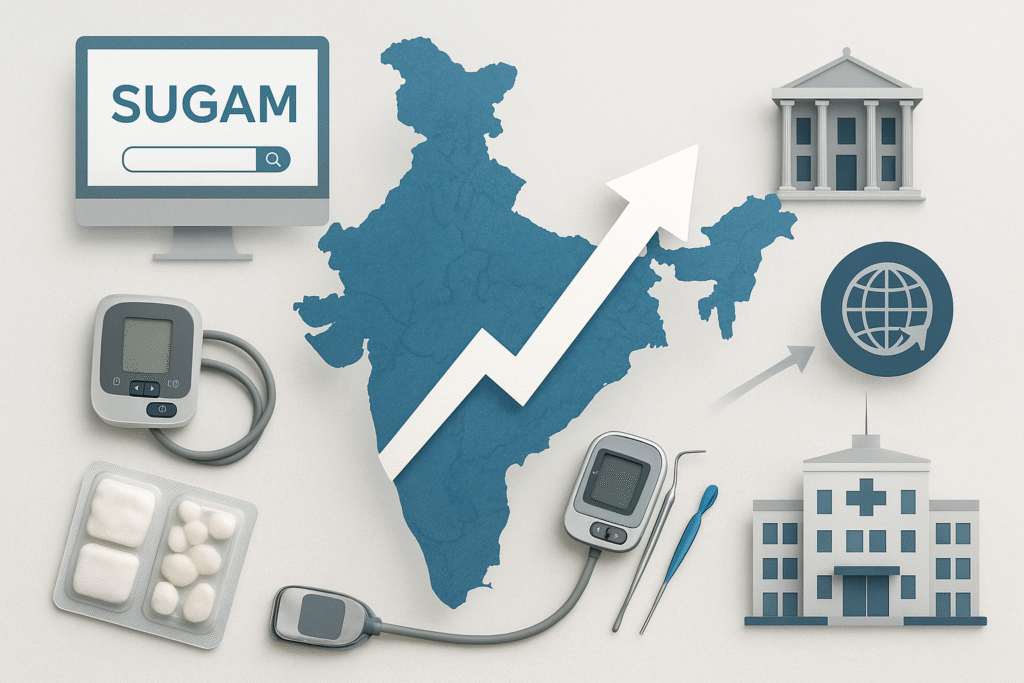
India’s medical device ecosystem is undergoing one of its fastest periods of regulatory growth, and the clearest indicator is the sharp rise in Class A and Class B registrations across therapeutic categories. As 2025 unfolds, this trend is expected to accelerate even further, driven by a mix of regulatory reforms, increased market demand, and the entry of both domestic and foreign manufacturers.
For companies exploring India as their next market, understanding this shift is essential not only from a compliance perspective but also for strategic decision-making. Here is a deeper look at why low-risk device registrations are booming and what this means for manufacturers planning their India entry strategy.
1. The Simplification of CDSCO’s Low-Risk Pathway Is Finally Paying Off
When the Medical Device Rules (MDR) were introduced, India committed to building a risk-based, predictable, and internationally aligned regulatory system. While implementation took time, the real outcome is becoming visible only now:
Class A and B devices enjoy the smoothest, fastest, and most business-friendly pathway under MDR.
Key advantages include:
- Lower documentary burden (compared to Class C/D)
- Shorter review timelines, often within weeks
- More predictable responses from CDSCO
- Reduced dependency on clinical investigation data
- Alignment with ISO 13485 + basic safety testing
In 2024–25, both Indian SMEs and global manufacturers have realized that Class A/B registration is not only straightforward but also an excellent first-step entry route into India.
2. Hospitals Are Shifting Toward Affordable, Easily Deployable Devices
Indian hospitals especially Tier 2, Tier 3, and fast-growing private chains are prioritizing devices that are:
- cost-effective
- easy to deploy
- easily maintainable
- backed by consistent supply
This naturally pushes them toward low-risk Class A and B products, such as:
- wound care devices
- surgical disposables
- bedside instruments
- monitoring accessories
- low-risk electro-medical systems
Since procurement cycles are faster in these categories, manufacturers see quicker adoption and revenue, encouraging more companies to register such devices first.
3. “Ease of Doing Business” Reforms Are Making India Attractive
India is aggressively positioning itself as a global medical device hub.
To support this, CDSCO has implemented visible improvements:
· Digital-first submissions through SUGAM
More processes are now fully online, reducing delays.
· Clearer classification guidance
Manufacturers can better determine whether their device fits Class A or B, reducing confusion and back-and-forth.
· Improved coordination with notified bodies
For Class A (non-sterile, non-measuring) devices, notified body certifications under ISO 13485 accelerate approval.
· State-level support & MedTech parks
States like Gujarat, Telangana, and Tamil Nadu have created incentives for manufacturing low-risk devices.
Together, these reforms create a regulatory environment where low-risk devices can reach the market quickly, and companies are responding accordingly.
4. Foreign Startups & SMEs Are Using Class A/B Devices as a Strategic Entry Point
A major new trend is the rising interest from:
- European SMEs
- US-based MedTech startups
- ASEAN manufacturers
- Middle Eastern distributors entering India as importers
Instead of starting with complex equipment, these companies are first registering:
- accessories
- consumables
- simple electronic systems
- diagnostic kits (B category)
This strategy allows them to:
- test the Indian market,
- build distributor networks,
- understand pricing dynamics,
- generate early revenue, and
- establish regulatory history with CDSCO.
Once they gain market traction, they plan to expand into Class C and D categories.
5. Increase in Local Manufacturing Is Driving Class A/B Growth
India’s “Make in India” and PLI schemes have pushed more domestic companies to start producing:
- surgical disposables
- orthopaedic accessories
- dental consumables
- basic monitoring equipment
- wound management products
Since many of these fall under Class A/B, the number of applications has naturally grown.
Domestic manufacturers prefer these categories because:
- capital requirement is lower
- technology is easier to scale
- regulatory cost is minimal
- export opportunities open up post-ISO certification
This rise in local manufacturing has significantly contributed to application volumes.
6. Impact of the New Medical Device Rules Awareness Among Manufacturers
CDSCO, state drug authorities, and various industry associations have increased awareness drives about:
- risk classification
- regulatory pathway
- quality system compliance
- import vs manufacturing license requirements
As more companies gain clarity, fewer devices are being sold without registration.
This compliance push is rapidly expanding the number of legal market entries particularly in low-risk categories.
7. What This Means for New Manufacturers Entering India in 2025
The current trend presents a unique opportunity. If you are entering India for the first time:
Start with Class A/B devices when possible
This reduces financial and regulatory risk.
Expect faster approvals
Week-level timelines are becoming common when documentation is complete.
Prepare for high competition
Since many companies are entering this space, differentiation depends on:
- quality
- pricing
- distributor network strength
- after-sales availability
Use Class A/B approval as your “regulatory track record”
Once approved, adding Class C/D products becomes smoother because CDSCO recognizes your compliance maturity.
Conclusion
India’s surge in Class A and B registrations is not a short-term spike it is part of a larger structural shift in the medical device ecosystem. Regulatory clarity, digital systems, government push, and market demand are all aligning to make low-risk devices the fastest-growing category in 2025.
For manufacturers eyeing India, this is the ideal moment to establish presence, build networks, and scale step-by-step into higher-risk categories.
Sources
- CDSCO – Medical Device Rules, 2017 (Latest Amendments)
- CDSCO Device Classification Guidance for Class A & B Devices
- SUGAM Portal – CDSCO Notifications & Approval Data (2023–2025)
- Ministry of Health & Family Welfare – Ease of Doing Business Announcements for Medical Devices
- Press Information Bureau (PIB) – Updates on MedTech Parks & Make in India Initiatives
- Industry Reports: India MedTech Market Trends 2024–2025 (FICCI, ASSOCHAM, AIMED)